
Thanks To Inflation, The Typical American Family Took A $3,500 Hit This Year

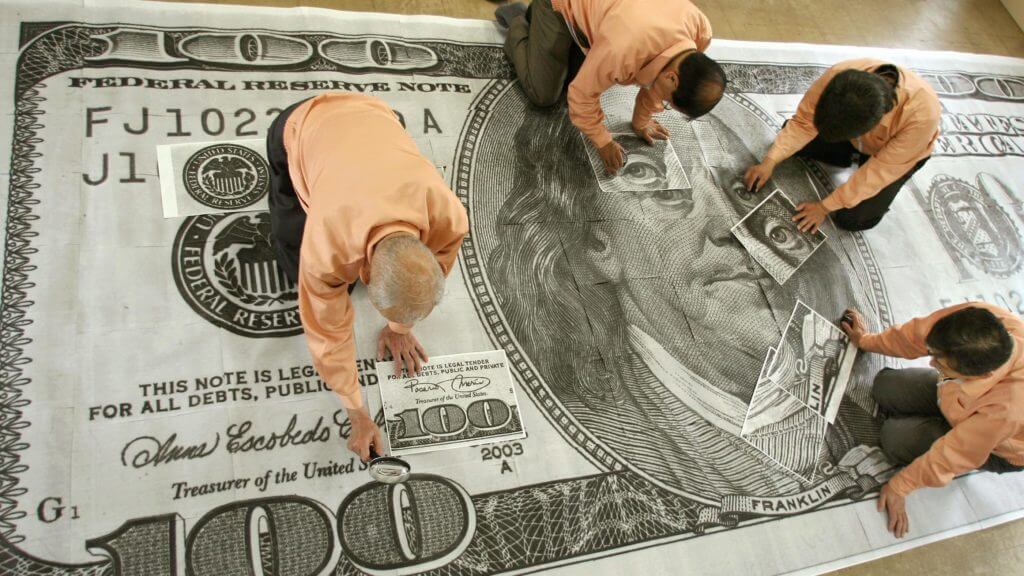
A new analysis shows that American families are experiencing a diminished standard of living due to high inflation.
The Bureau of Labor Statistics announced last week that consumer price inflation in the United States has reached a 6.8% clip — the largest year-over-year rate since June 1982, as well as the sixth straight month in which inflation remained above 5%.
On Wednesday, the Penn Wharton Budget Model — a nonpartisan public policy research initiative at the University of Pennsylvania’s Wharton School — found that inflation trends require the typical American household to spend around $3,500 more in 2021 to achieve the same level of consumption as in previous years.
The group explained that inflation is having a particularly tangible impact upon less advantaged families:
Since higher-income groups had a bigger increase in expenditures in all categories, they also saw a bigger increase in total expenditure. For example, the bottom 20 percent saw their total expenditure go up by $2,064 (under the fixed 2019 bundle) while the top 5 percent saw an increase of $8,326 (under the fixed 2019 bundle). Assuming the fixed 2020 bundle, these increases change to $2,160 and $7,636 respectively.
However, because of variation in the composition of consumption bundles, we find that higher-income households had smaller percentage increases in their total expenditure. Higher-income households spent relatively more on services, which experienced the smallest price increases. On the other hand, lower-income households spent relatively more on energy whose prices had large increases.
Under the fixed 2019 bundle assumption, the bottom 90 percent saw their consumption expenditure go up by between 6.7 percent to 6.9 percent in 2021. The top 5 percent, on the other hand, saw an increase of 6 percent. Under the fixed 2020 bundle assumption, the bottom 90 percent saw increases of 6.7 percent to 6.9 percent while the top 5 percent saw a 6.1 percent increase. Looking at the 60 to 80 percent quintile, those households saw an increased consumption expenditure of $4,441 (for the 2019 bundle) or $4,351 (for the 2020 bundle), representing an increase of 6.8 percent.


Responses